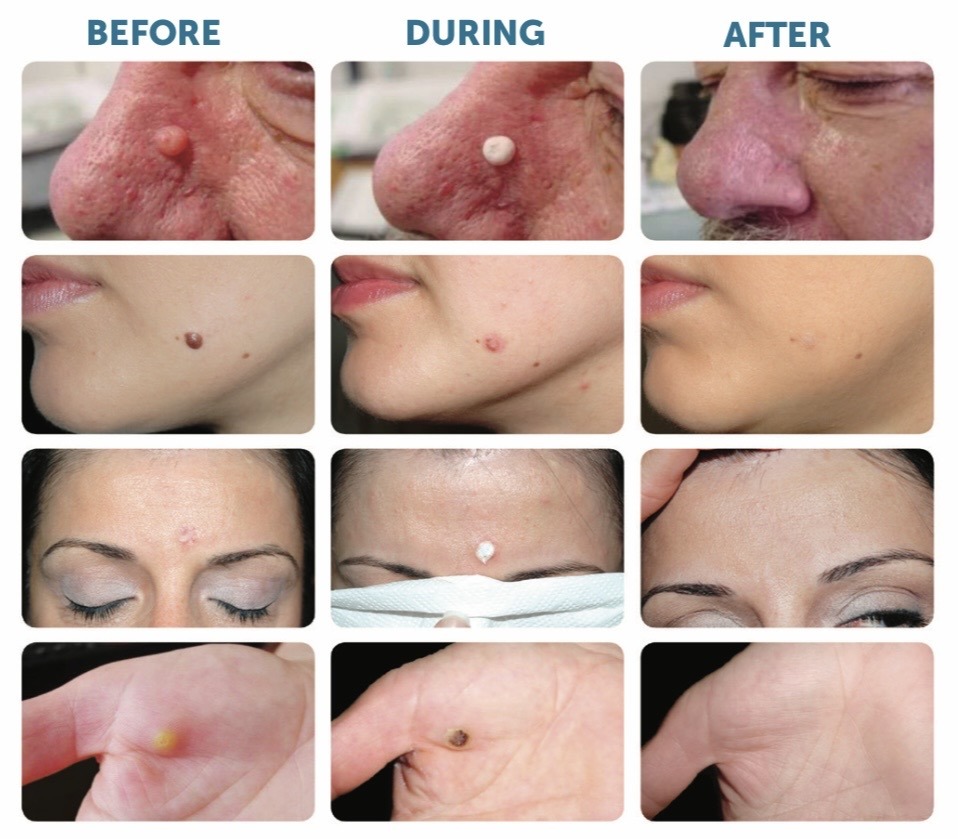
Cryopen - benign lesion removal
Delivers exceptional results for the removal of all benign lesions such as skin tags, seborrhoeic keratoses, cherry angiomas, warts, sun/age spots, certain pigmented lesions, milia, other superficial benign growths.
Areas Treated
face, neck, decolletage, hands, body
Discomfort Level
minimal
Treatment Time
15 to 30 mins
Cryopen - benign lesion removal
CryoPen is an advanced medical cryotherapy treatment used for the precise removal of benign skin lesions. It delivers a highly controlled jet of nitrous oxide to freeze unwanted tissue, causing targeted cellular destruction while preserving the surrounding healthy skin.
Cryotherapy is a long-established medical technique and remains one of the safest and most effective methods for removing many common benign lesions. The CryoPen device allows for exceptional accuracy, making it particularly suitable for visible and delicate areas where precision is essential.
All lesions are carefully assessed prior to treatment to confirm suitability. Only benign lesions are treated. If there is any uncertainty regarding diagnosis, I also offer the Map My Mole service where moles can be assessed by consultant dermatologists & treatment will not proceed until appropriately reviewed.
Most lesions will respond to a single treatment, however some deeper lesions may take several aggressive treatments to get results.
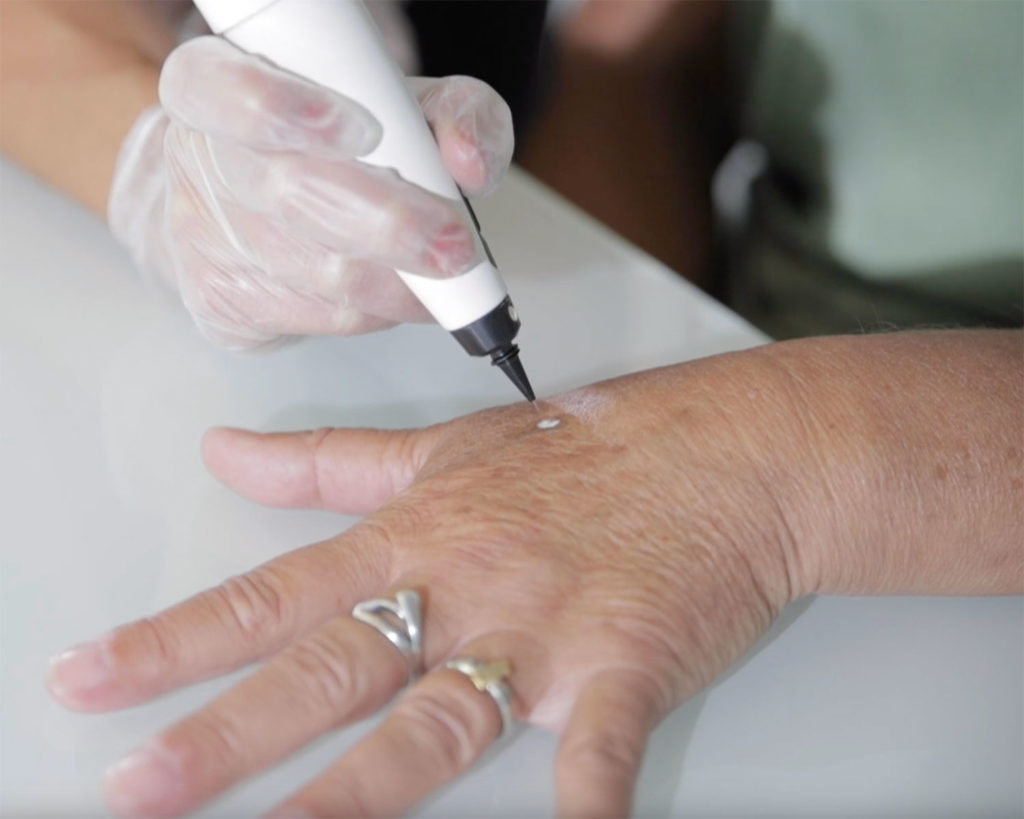
CryoPen works by delivering a short, intense freeze directly to the lesion. The rapid cooling causes ice crystals to form within the targeted cells, disrupting their structure. As the tissue thaws, the damaged cells are destroyed and naturally eliminated by the body
Treatment typically involves:
A brief freeze cycle lasting a few seconds
A thaw period
Often a second freeze cycle, depending on lesion depth and type
The depth of freeze is carefully controlled. As the cold penetrates the lesion, a brief sharp sensation may be felt. Treatment is stopped once the desired depth is achieved.
After treatment:
The area may appear red and slightly swollen
A blister may occasionally form and can persist for up to 5 days
The lesion will often darken or scab before gradually detaching
Healing time varies depending on the lesion type, depth and location, but typically ranges from 2 to 6 weeks.
While many benign lesions respond to a single session, some deeper or more resistant lesions may require multiple treatments spaced at appropriate intervals.
CryoPen can be used to treat a range of benign skin lesions including:
Skin tags
Seborrhoeic keratoses
Cherry angiomas
Warts
Sun spots
Certain pigmented lesions
Milia
Other superficial benign growths
Pigment changes can occasionally occur following cryotherapy. Both hypopigmentation and hyperpigmentation are possible, particularly in darker skin types. These changes are often temporary but can sometimes persist. This is discussed during consultation where relevant.
CryoPen can be used on:
Face
Neck
Décolletage
Hands
Body
Treatment parameters are carefully adjusted depending on the area and lesion characteristics. Special care is taken in delicate or highly visible areas.
Most patients describe the sensation as a brief cold sting lasting a few seconds during the freeze cycle. As the ice reaches the base of the lesion, a sharper sensation may be experienced momentarily. There may be mild residual stinging for a few minutes after treatment.
Discomfort is generally short-lived and well tolerated.
Treatment is quick and efficient. Appointments typically last 15 to 30 minutes depending on the number and size of lesions being treated.
The treated lesion may initially appear darker, slightly raised or blistered. A small scab often forms as part of the normal healing process.
Over the following days to weeks, the lesion will gradually dry and detach, revealing healed skin beneath.
Healing times vary depending on lesion depth and anatomical location.
For most benign lesions, cryotherapy provides permanent removal. However, some lesions are more resistant and may require additional sessions to achieve complete resolution.
New lesions may develop in the future due to genetics, sun exposure or natural skin ageing.
There are generally no significant restrictions following treatment. Normal daily activities can continue, including showering and swimming. The area should simply be protected from friction or trauma while healing.
If a blister forms and ruptures, gentle cleansing with an antiseptic solution is recommended. A light dressing may be applied to protect the area and support healing.
Follow-up can be arranged approximately 2 weeks after treatment if required to assess progress and determine whether further treatment is needed.