PRP for Rejuvenation & Hair Restoration
PRP for Rejuvenation & Hair Restoration
Treatment at a Glance
Areas Treated
Scalp, Face, Under-eyes, Neck and Decolletage
Discomfort level
Mild to moderate
Treatment Time
45-60 minutes
Results Begin
A few weeks
Typical Duration
Long-lasting
A considered approach
PRP for Rejuvenation & Hair Restoration
PRP (Platelet-Rich Plasma) is a natural, regenerative treatment that harnesses your body’s own healing potential. A small amount of your blood is taken and spun in a centrifuge, which separates it into its different components. This allows us to isolate the plasma with the highest concentration of platelets – and, importantly, the growth factors they release.
Rather than introducing anything synthetic, PRP concentrates what is already found within your own blood, and uses those growth factors to support your body’s own repair and regeneration.
PRP for hair restoration
Hair thinning and increased shedding are incredibly common in both men and women. When PRP is carefully injected into the scalp, its growth factors help support the hair follicles and create a healthier environment for hair growth – helping to improve hair density and thickness in suitable patients over time.
PRP for skin rejuvenation
PRP can also be used to improve skin quality in some of the most delicate and difficult-to-treat areas, including the under-eyes, fine lines around the mouth, the lower face and the neck. It improves fine lines, crepiness, texture and overall skin quality without adding volume.
At Rejuvenation by Dr Morag, PRP can be used on its own, or combined with treatments such as microneedling to enhance results.
Patient Questions
Frequently asked questions
What does the treatment involve?
Treatment begins with a consultation. For hair loss, this includes a full assessment of your hair and scalp, as there can be many different causes of hair thinning, and PRP is not suitable for every type of hair loss. Blood tests may be recommended to rule out other causes.
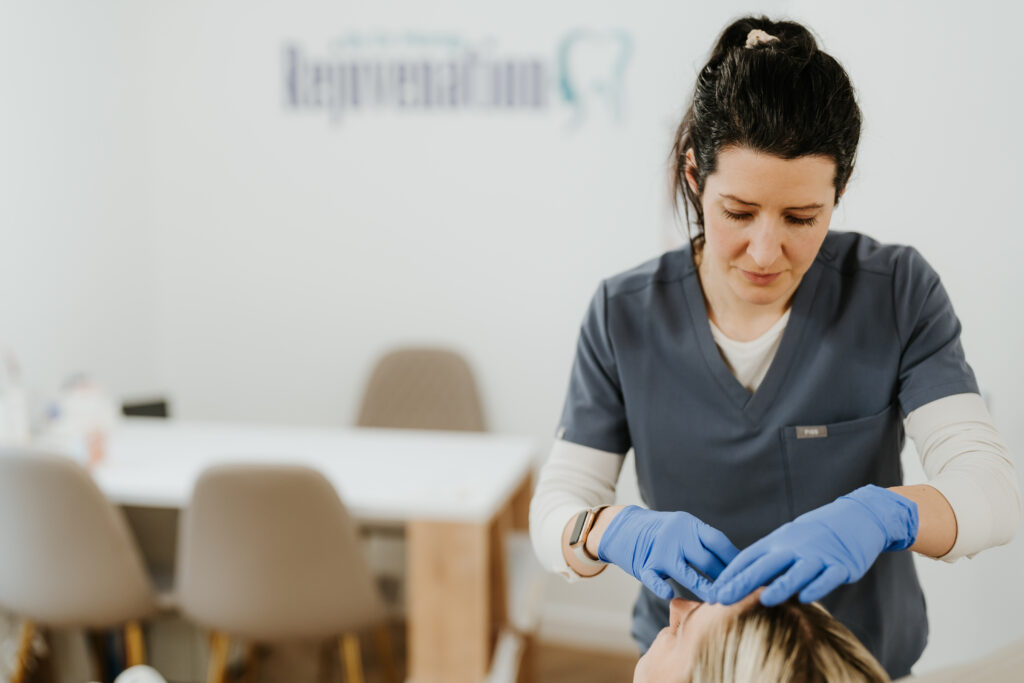
On the day, a small blood sample is taken from your arm, similar to a routine blood test. This is spun in a centrifuge to separate the platelet-rich plasma, which is then injected into the scalp or skin using fine needles.
What areas can be treated?
RP is commonly used to treat:
- Thinning hair and increased shedding in men and women
- Under-eye crepiness and dark circles
- Fine lines around the mouth
- Crepey skin on the lower face and neck
- Uneven texture and dull skin
- Decolletage
Suitability for each area will be assessed during consultation.
What is the discomfort level?
Most patients find treatment very manageable. Numbing cream is applied to the skin before facial treatment, and the scalp can be numbed to keep you comfortable. You may feel a scratch and some pressure with each injection.
How long does treatment take?
An appointment usually takes 45 – 60 minutes, including the blood draw, preparation of the PRP, numbing and treatment.
Is there any downtime?
Downtime is minimal. The treated area may be red, tender or mildly swollen for 1 – 3 days, and small bruises can occur, particularly under the eyes.
After scalp treatment, we recommend avoiding washing your hair for the rest of the day, and avoiding hair dye and heavy exercise for 48 hours.
How many sessions will I need?
Hair restoration: a course of 3 – 4 sessions, spaced 4 weeks apart
Skin rejuvenation: a course of 3 sessions, spaced 4 – 6 weeks apart
When will I start to see results?
PRP works gradually, as it supports your body’s own regeneration. For skin, improvements in texture and glow are often noticed within a few weeks, continuing to build over 3 months.
For hair, reduced shedding is often the first sign of improvement, with visible changes in density and thickness usually seen from around 3 – 6 months.
How long will results last?
Results are long-lasting but not permanent, as the natural ageing process and underlying causes of hair loss continue. Maintenance treatments are usually recommended every 4 – 6 months for hair, and every 6 – 12 months for skin.
Is it suitable for everyone?
PRP is suitable for many patients, but it is not recommended for anyone with certain blood or platelet disorders, active infection, some cancers, or during pregnancy or breastfeeding. Some medications, including blood thinners, may affect suitability – this will all be checked at your consultation.